
Foundation Repair in Duluth, MN
Duluth homes sit on terrain that doesn’t stay still. The hillsides above Lake Superior are built on glacial clays and silts that swell with snowmelt in spring, pull away from foundations in dry summers, and freeze solid every winter. In neighborhoods like East Hillside, Lincoln Park, Lakeside, and Piedmont Heights, that cycle shows up over time as cracks in basement walls, floors that tilt toward the downhill side of the house, or walls that no longer look quite straight when you sight down their length.
SafeBasements has been working on foundations across Minnesota for over 35 years. Using engineered SafeBase systems, our crews stabilize settling foundations, reinforce bowing or leaning basement walls, and support sagging floors with repairs built around your home’s specific soil conditions and layout. Every project starts with a free inspection and a written repair plan so you understand exactly what’s happening before any work begins.

Signs Your Duluth Home May Have a Foundation Problem
Foundation trouble rarely arrives as a single dramatic event. It tends to show up as a collection of small changes that keep recurring: a crack that reappears after patching, a door that started sticking last winter and never quite freed up, a floor that feels different than it used to. When several of these show up at the same time, it’s worth having the foundation looked at.
Cracks in the basement walls or floors
New cracks, or cracks that are visibly longer than they were last year, are one of the most common signs of foundation movement. In Duluth basements, that can look like stair-step cracking through block walls, vertical cracks at window and door corners, or a horizontal crack running across the middle of a wall. On the floor, watch for slab cracks that have shifted out of level, or that let in water during the spring thaw. These aren’t cosmetic issues that can be patched over and forgotten.
Floors that slope, dip, or feel soft
Homes on Duluth’s hillsides can develop floors that lean toward the downhill side as soil shifts or supports settle. You might notice furniture that slowly migrates toward one wall, or a dip in a specific room that you feel every time you cross it. Floors that feel spongy or bounce slightly underfoot usually point to beams and joists that are no longer well supported below. Both are worth investigating.
Doors and windows that stick or no longer close properly
When a foundation shifts, the frame of the house moves with it. Interior doors that used to latch cleanly may start jamming, scraping the top of the frame, or swinging open on their own. Windows that opened easily may stick halfway or leave gaps at the corners where they once sealed tightly. When several doors and windows in the same house start acting up around the same time, that pattern usually points to settlement or shifting walls rather than a humidity issue.
Bowing or inward-leaning basement walls
Bowing walls are a serious sign of structural pressure. In Duluth, the clay soils on the uphill side of a home push hard against concrete or block walls, especially as those soils cycle through wet and frozen states year after year. A wall that bulges inward, a long horizontal crack through the middle, or blocks that are visibly no longer in a straight line all indicate that lateral pressure has been building. This kind of movement does not correct itself.
Gaps and separations around the structure
Foundation movement often shows up where two materials meet. Inside the house, you might see baseboards pulling away from walls, trim separating at corners, or ceiling lines that no longer meet the wall cleanly. Outside, a gap between the foundation and an adjacent sidewalk or a chimney pulling slightly away from the house both suggest that parts of the structure are settling at different rates.
Water intrusion alongside structural changes
In Duluth, water problems and foundation problems frequently appear together. When a wall is cracking and leaning in the same area where water seeps in during heavy rain or spring runoff, that combination usually calls for more than caulk or waterproof paint. The structural issue and the water issue need to be addressed together, or neither fix holds for long.

What Causes Foundation Problems in Duluth?
Most foundation problems here trace back to the same three forces working on a house over a long period of time: unstable glacial soils, deep frost cycles, and water with nowhere good to go.
The clay-heavy ground that covers much of Duluth’s residential hillsides soaks up water readily and releases it slowly. In neighborhoods like East Hillside and Piedmont Heights, spring snowmelt saturates the soil for weeks, swelling it against basement walls and footings. By late summer, that same soil has dried and contracted, pulling slightly away from the foundation and changing how loads are distributed. Over the years, one side of a footing can lose meaningful support while the other stays firm, and the house begins to crack or settle in the direction of least resistance.
Frost depth adds to this. In a hard Duluth winter, the ground can freeze three to four feet down. That frozen soil expands as it locks up, lifting and shifting whatever sits on top of it. When it finally thaws in April or May, it settles again, rarely quite back to where it started. Homes in the steeper parts of the city absorb a small amount of net movement every single year.
Water is the third factor. Duluth accumulates heavy snowpack, then releases it quickly during spring melt. A significant summer storm can push the same volume downhill in an afternoon. When downspouts discharge near the foundation, when a yard pitches toward the house instead of away from it, or when there’s no drainage system managing runoff, water collects along the outside of basement walls and stays there. That sustained hydrostatic pressure works on every crack and seam, slowly widening openings and contributing to wall movement over years.
Older construction makes all of this harder on the house. Many Duluth homes were built before modern foundation codes, with shallow footings, stone or block walls not designed for decades of clay movement, or additions set on different footing depths than the main structure. As those pieces respond differently to the same soil and weather, diagonal cracks at door corners, separating trim, and chimneys pulling slightly away from the house are the visible results.
Foundation Repair Services in Duluth
SafeBasements looks at how your home was built, how it sits on the lot, and what the cracks and movement patterns are actually showing, then matches that to a repair plan built around SafeBase products designed for this kind of work.
Foundation crack repair
Not every crack signals the same problem. Some cracks are from normal concrete shrinkage. Others indicate settlement, lateral pressure, or water intrusion working through the wall. During inspection, a technician looks at where the crack sits, its width and direction, whether it passes through poured concrete or steps through block, and whether water has been entering. The repair addresses both the crack itself and, where needed, the underlying stress causing it.
Stabilizing settling foundations with push piers and helical piers
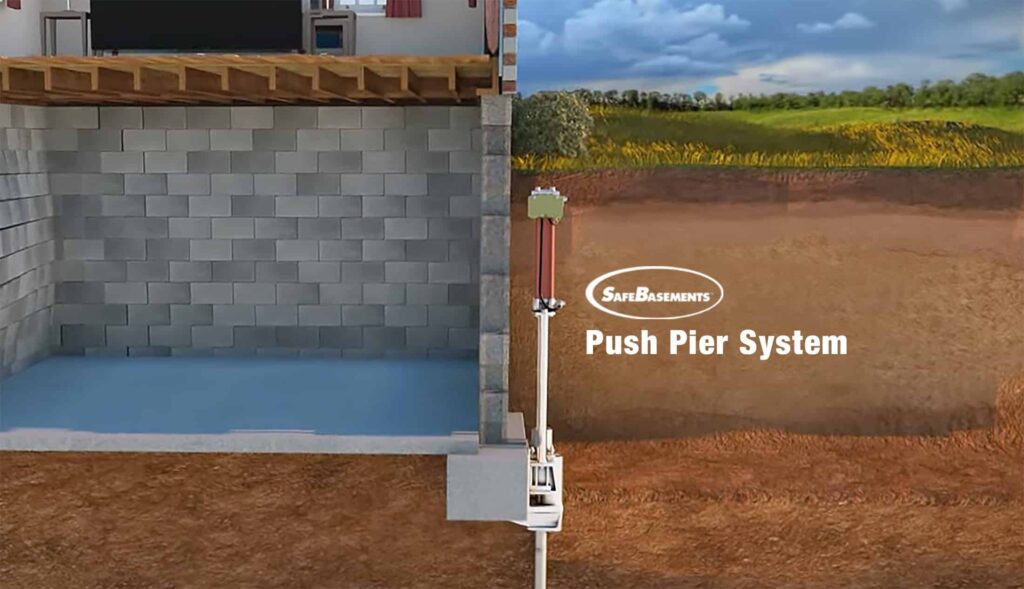
When a section of foundation has dropped because the soil beneath it can no longer carry the load, piers transfer that weight to stable ground below. SafeBase Push Piers are driven down beside the footing until they reach solid bearing. SafeBase Helical Piers are screwed into the ground to a depth and torque that confirms stable support. Steel brackets connect each pier to the foundation, stopping further settlement and, in many cases, allowing the structure to be lifted back toward its original position.
Repairing bowing and leaning basement walls
The right solution for a bowing wall depends on how much it has moved and what access is available. For walls with significant deflection, SafeBase Wall Anchors connect through the wall to stable soil beyond the foundation and can be gradually adjusted over time to help straighten it. Where outside access is limited, SafeBase Waler Wall Supports use steel beams to redistribute pressure and tie the wall into the floor and joists above. For walls showing early-stage movement, SafeBase Carbon Fiber Straps lock the wall in place without significantly reducing basement space.
Addressing foundation leaks tied to structural movement
When cracks in a wall are actively leaking during the spring thaw, or when seepage appears along the base of a wall that is also starting to lean, the structural problem and the water problem need to be handled together. SafeBasements seals the crack or joint to stop water from entering, and where appropriate, adds drainage or waterproofing components to reduce ongoing pressure on the wall.
Floor and crawl space support
Many older Duluth homes have crawl spaces or basements where beams and joists have carried more load than intended for decades. The result is sagging or soft floors on the main level. SafeBasements installs SafeBase Floor Stabilizers beneath those beams to provide new vertical support. These adjustable steel columns sit on proper footings and are tightened carefully to bring floors back toward level without putting sudden stress on the structure above.
Why Duluth Homeowners Choose SafeBasements
Choosing someone to repair a foundation is different from hiring out most other home projects. The work goes under the house and needs to hold up through years of the same frost cycles, clay movement, and runoff that created the problem in the first place.
SafeBasements has over 35 years of foundation repair experience across Minnesota, including work in hillside neighborhoods, lake-adjacent properties, and older city streets with the kinds of block foundations and shallow footings that are common in Duluth. Our repair recommendations come from that experience, not a generic checklist.
The systems we install are engineered structural products matched to the specific home based on what the inspection reveals: how the house sits on the slope, what the soil and crack patterns suggest, and which type of movement is actually happening. Our crews are certified, not subcontracted, and they work in Minnesota year-round. They know what it means to work on a steep Duluth lot with a narrow driveway, a tight alley, or a finished basement that needs to be protected during the repair.
Most foundation repair systems carry a lifetime transferable warranty. That means the coverage follows the home if you sell, which matters to buyers in this market who know what foundation problems cost.
Inspections are free. The repair plan is written out before you decide anything. Pricing is itemized, not estimated in vague ranges.
Schedule a Free Foundation Inspection in Duluth
Cracks grow slowly. Walls bow a little more each winter. Floors that slope today will slope further in five years. Foundation problems in Duluth don’t tend to stabilize on their own because the conditions driving them don’t go away.
If you’re seeing any of the signs described on this page, the most useful thing you can do is have someone look at the foundation before the problem advances to a more involved repair. A SafeBasements contractor will walk the basement and exterior with you, explain what they find in plain terms, and put together a written repair plan with clear pricing and full warranty details. There’s no charge for the inspection and no obligation to proceed.
Contact us to schedule your free inspection today. The sooner the foundation movement is caught, the simpler and less costly the repair tends to be.
Frequently Asked Questions (FAQs)
The cost of foundation repair in Duluth, MN, depends on various factors, including the size, type, and condition of your foundation. Moreover, the solutions selected also affect the cost. We can provide you with a detailed quote after we inspect your property.
Insurance companies usually only cover the foundation and basement repair in Duluth as long as a covered event, such as an accident or natural disaster, causes the damage. For more information, we recommend getting in touch with your insurance provider.
The time needed for a foundation repair depends on the kind of repair we are performing. In some cases, the repairs can be done in a few hours. However, extensive repairs may take up to three days or more. After a free inspection, we will give you a complete timeline of the project.
Some types of basement and foundation repairs, such as push piers, require digging and excavation, but it’s not always necessary. We only excavate around your foundation if absolutely necessary. After inspecting your property, we will recommend and explain the most effective foundation property.
SafeBasements has different warranty options for different types of foundation repair services. On almost all of our services, we offer transferable warranties ranging from 25 years up to a lifetime. We will give you further details about the warranty coverage after inspecting your property and recommending the most effective solutions.